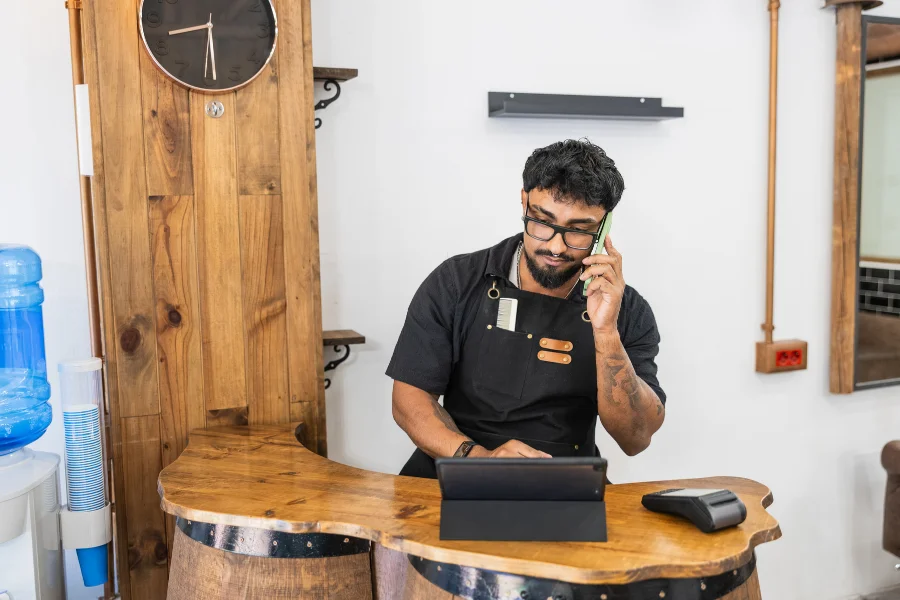
An AI receptionist for a small business answers the phone, handles routine bookings and questions, and hands off anything it can't manage to a person, all for less than the cost of part-time staff, and without the setup complexity the category's marketing sometimes implies. The real question for most owners isn't whether the technology works; it's whether it fits how their specific business actually takes calls.
What "AI receptionist" actually means for a small business
An AI receptionist is software that answers a business's phone line, holds a natural conversation with the caller, and completes routine tasks (booking an appointment, answering a common question, taking a message with real detail) without a person picking up. For a small business specifically, the practical value isn't "24/7 coverage" as an abstract feature; it's that a single owner or a small team physically cannot answer the phone while also doing the work the business exists to do. A hairdresser mid-appointment, a plumber under a sink, a shop owner helping a customer. None of them can also be on a call.
That's different from what a small business had available before: voicemail, which loses the caller entirely, or hiring part- or full-time reception staff, which is a real cost most small businesses can't justify for a role that's often idle much of the day and completely unstaffed the rest of it.
The three myths that stop small businesses from trying one
A few specific concerns come up constantly with small business owners considering this, and most are outdated or overstated.
"It'll sound robotic and annoy my customers." Early phone automation, the "press 1 for sales" era, earned this reputation fairly. Modern systems hold a natural back-and-forth conversation rather than following a rigid script, and many callers don't identify it as AI within the first few seconds, if at all. The honest caveat: voice quality does vary between providers, which is exactly why testing one on your own phone before committing matters more than reading about it.
"It'll replace me and make my business feel impersonal." For the large majority of small businesses, an AI receptionist absorbs the calls that would otherwise be missed entirely (after hours, during a job, when the phone rings twice at once) while the owner or staff still handle everything that benefits from a personal touch. It's addition, not replacement, for most use cases.
"It's too complicated or expensive to set up." This was truer a few years ago. Most current systems set up through call forwarding on an existing number (no new hardware, no phone system replacement) and can be configured around a business's actual services and hours without technical skills.

Which small businesses actually see a difference
The businesses that benefit most share one trait: the phone is a direct line to revenue, and a missed call is a missed booking, order, or job, not just a missed conversation. That covers a wide range: restaurants and cafés losing table bookings during service, clinics and salons where a single practitioner can't answer mid-appointment, trades businesses where a missed emergency call goes straight to a competitor, and retailers fielding stock and order questions during their busiest hours.
The businesses that see less value are ones where calls are rare, low-stakes, or rarely need anything beyond hours and directions. A business with genuinely light call volume may find a simpler, cheaper option sufficient. The honest way to check which category a business falls into is to look at actual call logs or voicemail history for a couple of weeks: how many calls come in outside working hours or while staff are busy, and what those callers actually wanted.
Where a human still matters
An AI receptionist handling routine calls well doesn't mean every call should go to it. Genuinely sensitive situations, complex negotiations, an upset customer who needs to be heard rather than processed, or anything requiring judgment a script can't anticipate: these still need a person, and a well-configured system should recognize that and hand off rather than attempt to push through. The practical model most small businesses land on isn't "AI instead of a person," it's AI absorbing the routine and repetitive volume so the time a person does spend on the phone goes to the calls that actually need them.
What it actually costs a small business
Pricing generally follows a flat monthly fee for a set call volume or a usage-based rate that scales with calls or minutes. Both are cheaper than a part-time staff member, and available at hours no single employee can realistically cover. The right comparison isn't the monthly fee in isolation; it's that fee against what a business is currently losing to calls that go to voicemail or ring out unanswered, which is usually the more revealing number for an owner who hasn't looked at it directly before.
What actually varies the price is what's included: a system that only answers and takes a message costs less than one that also books directly into a calendar, sends confirmations, and handles multiple languages natively. Our own plans start at €29 a month, with €59, €149 and €289 tiers above it and a one-off €149 to set the system up around your business. Two languages are included in every plan and an extra one is €29 a month; calls beyond your plan run at that plan's own rate, €0.39 to €0.59 a minute. The current list is on the pricing page.
How to try one without betting the business on it
The lowest-risk way to evaluate this isn't reading reviews. It's routing overflow or after-hours calls to a system for a limited period first, rather than switching every call over on day one. That gives a real sense of call volume, common questions, and how the system handles them, without staff needing to trust it completely before it's proven itself. Most providers, including phone-assistant.ai, offer a demo built around the specific business rather than a generic script, which is a faster way to judge fit than any amount of reading. If you have already decided to adopt one and are comparing providers, how to choose an AI phone answering service covers what to look at.
What the first week actually looks like
Setup typically starts with configuring the AI around the business's actual services, hours, and common questions: what a restaurant's table plan looks like, what a salon's booking rules are, what a trades business treats as an emergency. Call forwarding is then set up on the existing number, usually for overflow or after-hours calls first rather than everything at once. Over the first week or two, most owners review the transcripts or summaries from real calls and adjust anything that came up that wasn't anticipated in setup. A question the system couldn't answer, a booking rule that needed clarifying. That iteration period is normal and expected, not a sign something's wrong.
Frequently asked questions
Is it worth it for a solo operator, or only bigger businesses?
Often more so for a solo operator than a larger business, since a one-person operation has nobody else to answer the phone while they're working. Every missed call is a call that simply goes unanswered rather than picked up by a colleague.
Will my customers know they're talking to AI?
Often not immediately, since modern systems use natural-sounding voices and hold real conversations rather than following a rigid script. Under current EU transparency rules, a well-configured system should make this clear early in the call regardless, in a natural, non-disruptive way.
Do I need any technical skills to set it up?
No, in most cases. Setup is typically a conversation about how the business works (services, hours, common questions) followed by call forwarding on the existing number, both of which a provider walks a business through directly.
What happens if it makes a mistake or misunderstands a caller?
A well-configured system recognizes when it's outside its depth and hands off to a person rather than guessing, and every call is typically logged so mistakes can be reviewed and the setup adjusted afterward.
Can I turn it off or scale back if it's not working for my business?
Yes, in almost all cases, since these systems work through call forwarding rather than a permanent number or system change, turning it off means redirecting forwarding back, not unwinding an integration.
Does this work for businesses outside the US and UK?
Yes: phone-assistant.ai specifically serves businesses across the EU, UK, and US, and handles calls in English, Dutch, German, French, and Turkish.