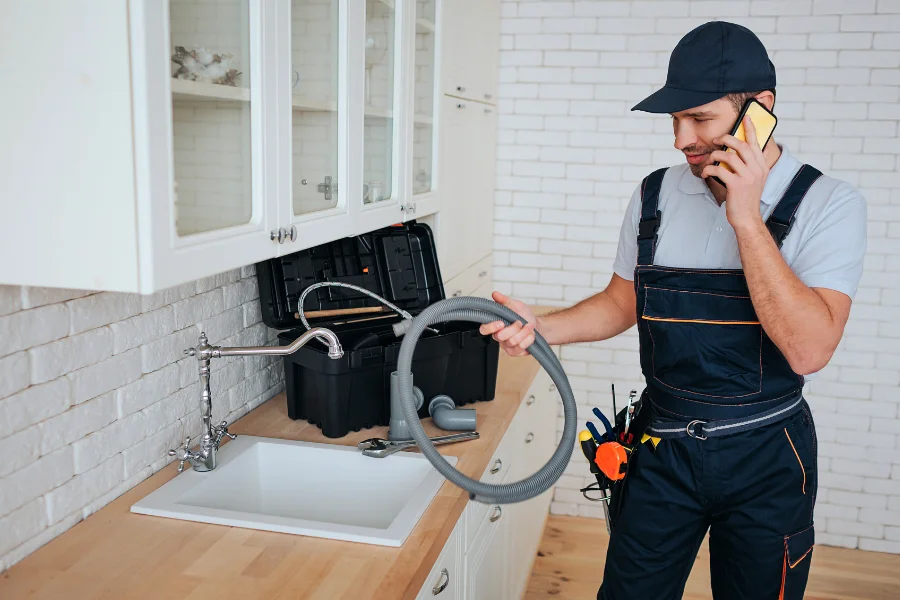
An AI answering service for a trades business answers the phone while you're on a job, works out whether the call is an emergency or routine, books the job straight into your calendar, and sends a WhatsApp or text update to both you and the customer, all without you stopping what you're doing to pick up.
What an AI answering service actually does for a trades business
An AI answering service for a trades business is a voice system that answers the business phone line, holds a real conversation with the caller about what they need, and either books the job or flags it for immediate attention, depending on urgency. This matters more here than in most other businesses: a plumber under a sink, an electrician in a consumer unit, or a mechanic mid-repair genuinely cannot stop to take a call, and a solo tradesperson or small crew has nobody else to hand the phone to.
That's a different job from voicemail, which just records a message the caller has already moved past by the time anyone listens to it, and a different job from a basic human answering service, which can take a message but usually can't see your actual calendar or tell a burst pipe from a routine quote request without you setting up detailed scripts in advance. The category as a whole is covered in what an AI receptionist is; this page is about the version built for a business where the phone rings while your hands are full.
How it handles a call, from ring to booked job
A call to an AI answering service for a trades business follows a consistent pattern:
- The AI answers with the business name and a natural greeting, the same way a person would.
- The caller explains the problem in their own words ("my boiler's stopped working" or "I've got a socket that's sparking") without navigating a menu.
- The AI works out urgency, distinguishing something that needs an immediate response from something that can wait for the next available slot.
- For a routine job, it checks the real calendar and offers available times; for something urgent, it collects the details needed to act fast: address, access instructions, what's actually happening.
- It confirms next steps out loud and sends automatic follow-up: a booking confirmation to the customer, and a notification to you or whoever's on call.
The same flow handles a reschedule or a callback request: the AI pulls up what's already booked, adjusts it, and confirms the change.
AI answering service vs. voicemail vs. a human answering service
A trades business usually already has some way of catching calls it can't answer live, and it's worth being clear about what an AI answering service adds that the alternatives don't.
| Voicemail | Human answering service | AI answering service | |
|---|---|---|---|
| Responds in real time | No | Yes | Yes |
| Distinguishes urgent from routine | No | Depends on script quality | Yes, on most systems |
| Books directly into your calendar | No | Rarely | Yes, on most systems |
| Available 24/7 | Yes (passively) | Rarely | Yes |
| Cost pattern | Free/low | Per-minute, adds up fast | Flat or usage-based |
A human answering service can be a reasonable stopgap, but it's disconnected from your actual schedule most of the time. Someone still has to turn a message into a booked job afterward, which is exactly the manual step an AI answering service is built to remove.

Emergency triage: the single most important feature
For a trades business, the difference between a good and a mediocre AI answering service almost always comes down to one thing: can it actually tell an emergency from a routine enquiry, in the first thirty seconds, from natural language rather than a keyword list. "My basement's flooding" and "I'd like a quote for a new socket" need completely different responses, and a system that treats them the same either buries genuine emergencies in a batch of routine messages or panics you over every minor request.
A well-built system recognizes urgency from how the caller describes the problem, collects the specific details that matter for that trade (the address, what's affected, whether water or power needs to be shut off) and gets that information to you or an on-call technician immediately rather than waiting for a morning summary. It's also worth being clear about the limit here: for a genuine safety risk (a strong gas smell, an electrocution risk, anything life-threatening) a properly configured system should direct the caller to emergency services first, before anything else, rather than trying to handle that itself. Triage is not the same as taking over a safety decision.
Booking the job and keeping everyone updated
Answering the call is the starting point; what happens next determines whether the system actually saves you time. A job that only exists as a note somewhere is barely better than a voicemail message. The value is in what fires automatically once the call ends.
A capable system books the job straight into your calendar in real time, so you're not manually transcribing details from a call log later. It sends the customer a confirmation, usually by text or WhatsApp, and gets you or the relevant technician a clear notification with the job details, rather than leaving you to check a dashboard between jobs. The same booking should stay in sync whether the customer called, messaged, or booked through your website, so you're never juggling two different lists. For higher-cost emergency callouts, some systems can also send a payment link or take a small deposit during the call, which is a practical way to filter out price-shoppers before you drive out. Bubo runs this as one connected sequence (booking, WhatsApp update, and payment link where relevant) and keeps it in sync with the trades and automotive pages. The full feature list covers how each piece works.
What happens when a customer speaks another language
Most AI answering services are built around a single language, and a caller who doesn't speak it either struggles through the call or hangs up and rings the next name on the list, which, for a trades emergency, often means losing that job entirely. In a CSA Research survey of 8,709 consumers across 29 countries, 76% said they prefer to buy from a business that communicates with them in their own language, and 40% said they wouldn't buy from a business that couldn't. For a trades business, that purchase decision is often made under time pressure, which makes the effect sharper, not smaller.
This shows up constantly for trades working in mixed-language cities, near borders, or in areas with a large non-native-speaking population. A burst pipe doesn't wait for someone to find an English speaker to call on your behalf. A system that detects the caller's language automatically and holds the entire conversation in it, rather than switching mid-call or defaulting to one script, captures jobs that a single-language system simply misses. Bubo does this across English, Dutch, German, French, and Turkish, with no manual language-selection step before the caller reaches a real conversation.
What it costs
Pricing for AI answering services in this category generally follows one of a few structures: a flat monthly fee for a set number of minutes or calls, or a usage-based rate that scales with volume. Neither is automatically better. A business with steady call volume usually does better on a flat plan, while one with sharp seasonal swings (a heating engineer who's quiet in summer and slammed the moment it turns cold) may prefer usage-based pricing so it isn't paying for capacity it doesn't need most of the year.
What actually moves the price is what's included: whether the system does real emergency triage or just answers and takes a message, whether it books directly into your calendar, whether it sends WhatsApp updates, and whether it handles your customers' actual languages natively. Our own plans start at €29 a month, with €59, €149 and €289 tiers above it and a one-off €149 to set the system up around your business: hours, services, booking rules. Two languages are included in every plan and an extra one is €29 a month; calls beyond your plan run at that plan's own rate: €0.39 to €0.59 a minute, and the line keeps answering. The current list is on the pricing page.
What to check before choosing one for your business
A few questions separate a system built for this kind of business from a generic call-answering tool:
- Does it actually distinguish urgent from routine calls, or treat every call the same way?
- Does it check your real calendar and book directly, or just take a message you still have to act on?
- What happens with a genuine safety emergency: does it know its limits and point the caller to emergency services first?
- Does it speak your customers' actual languages natively, without a manual switch mid-call?
- What fires automatically after the call: a customer confirmation, a technician notification, nothing?
- Does it work with your existing number, or does it require new hardware or a number change?
Frequently asked questions
Can it tell a real emergency from a routine call?
Yes, on a well-built system. It works out urgency from how the caller describes the problem (a burst pipe or total power loss gets treated differently from a request for a quote) and gets urgent details to you or an on-call technician immediately rather than waiting for a batch summary.
Does it replace me answering calls myself?
Not for most businesses. It catches the calls you'd otherwise miss entirely (while you're under a job, driving, or after hours) while you still handle the calls you're free to take and anything that needs your direct judgment.
Can it book directly into my calendar?
Yes, on most systems. It checks your real availability and books the appointment during the call itself, rather than promising a callback and leaving the scheduling to you afterward.
What happens with a genuine safety emergency, like a gas leak?
A properly configured system directs the caller to emergency services first, before attempting to handle anything itself. Triage means recognizing urgency and collecting useful details. It doesn't mean the AI takes over a decision that needs an emergency response.
Does it work with my existing number?
Yes, in almost all cases. It works through call forwarding rather than replacing your number, so customers keep calling the number they already have.
Can it collect a deposit for an emergency callout?
Some systems can. A payment link or small deposit sent during the call is a practical way to confirm a caller is serious about an emergency callout before you commit time to drive out.